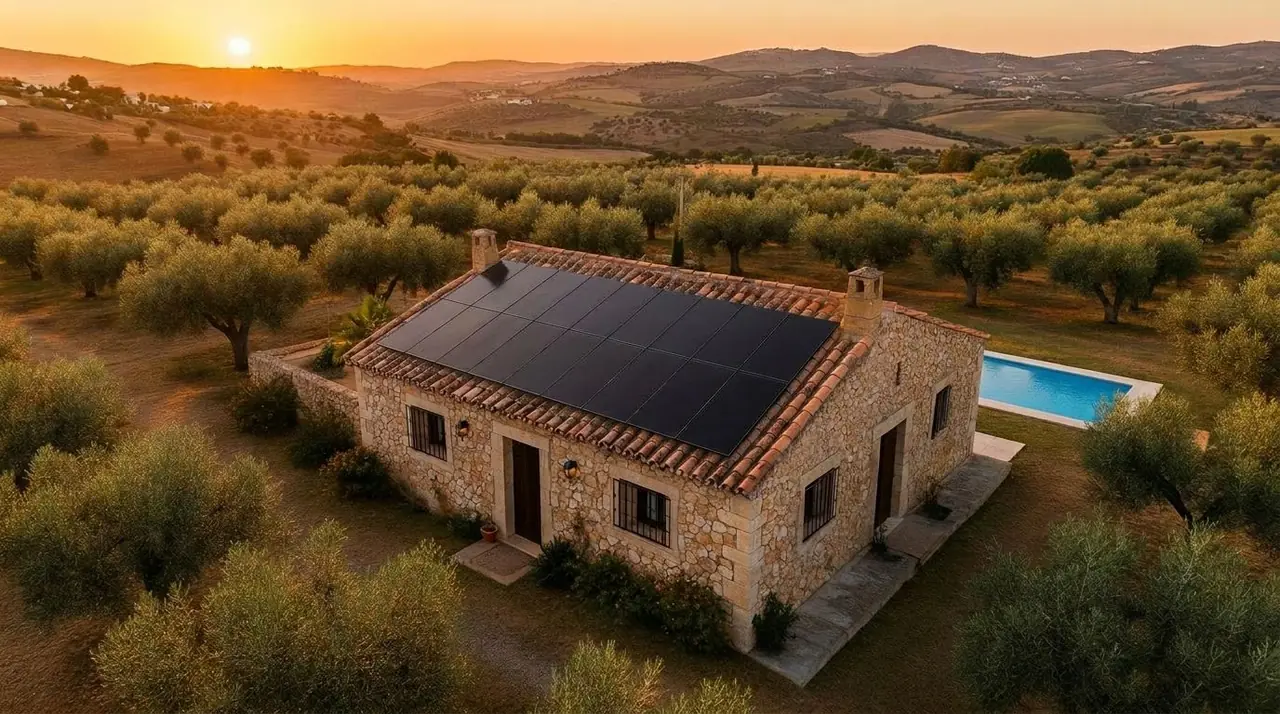

Andalusia Sets Strict 2030 Net-Zero Targets: Solar Now Essential
New regional climate mandates in Andalusia are accelerating the transition to renewable energy for residential properties. Homeowners on the Costa del Sol can future-proof their assets and eliminate rising grid costs by installing high-efficiency solar and storage systems today.
The regional government of Andalusia has significantly increased the pressure on decarbonization, setting ambitious targets for 2030 that place renewable energy at the core of every residential property strategy. As the European Union tightens its Green Deal directives, Andalusia is positioning itself as a leader in the transition, aiming for a drastic reduction in CO2 emissions. For homeowners from Malaga to Estepona, this shift is no longer just an environmental choice but a financial and regulatory necessity. The legislative framework is evolving to favor self-consumption, making the adoption of clean energy the most effective way to protect property value and ensure compliance with future building standards.
Under the Spanish legal framework established by RD 244/2019, the process for legalization of solar systems has become streamlined, allowing residents to benefit from compensation for excess energy fed back into the grid. In the sunny climate of the Costa del Sol, the geographic advantage is immense. Typical PVGIS yields in areas like Marbella or Mijas often reach 1,700 to 1,800 kWh per kWp annually. This means a standard domestic array produces significantly more power than in Northern Europe, allowing for a typical payback period of just 5 to 8 years, depending on consumption patterns and the utilization of available incentives.
To bridge the gap between daytime generation and evening consumption, home battery storage Spain solutions have become the missing piece of the puzzle. By storing surplus energy generated during the peak sun hours, homeowners can achieve near-total energy independence, insulating themselves from the volatile prices of the Spanish electricity market. Furthermore, many municipalities in Andalusia offer substantial IBI (Property Tax) deductions of up to 50% for several years following a solar installation, alongside national IRPF (Income Tax) deductions that can recover a significant portion of the investment cost.
Sustainability on the Costa del Sol is also increasingly linked to mobility and heating. With the 2030 targets approaching, the demand for EV charger installation is surging as residents switch to electric vehicles. Integrating a charging point with a solar system allows for virtually free motoring. Similarly, replacing old gas or electric boilers with high-efficiency aerothermal systems is a key step in the regional energy strategy. These air-to-water heat pumps utilize the ambient temperature to provide heating, cooling, and hot water, perfectly complementing the power output of a residential solar array.
Local property owners should also consider the importance of long-term performance. Ensuring that your investment continues to yield high returns requires professional maintenance placas solares to keep the equipment running at peak efficiency. Dust and salt residue common in coastal environments can slightly degrade performance over time, making periodic cleaning essential. When a system is well-maintained and paired with a bateria virtual (virtual battery) service to manage credits for exported energy, the monthly electricity bill can effectively be reduced to the fixed connection fees alone.
The first practical step for any homeowner in Malaga or the surrounding areas is to obtain an updated certificado energetico (energy certificate). This document not only rates the current efficiency of the home but also highlights the improvements achieved through solar and storage. With the 2030 deadline for emission targets fast approaching, there has never been a more opportune moment to consult with a professional installer. Taking action now ensures you benefit from existing grants and tax breaks before the market becomes saturated by the mandatory requirements of the coming decade.