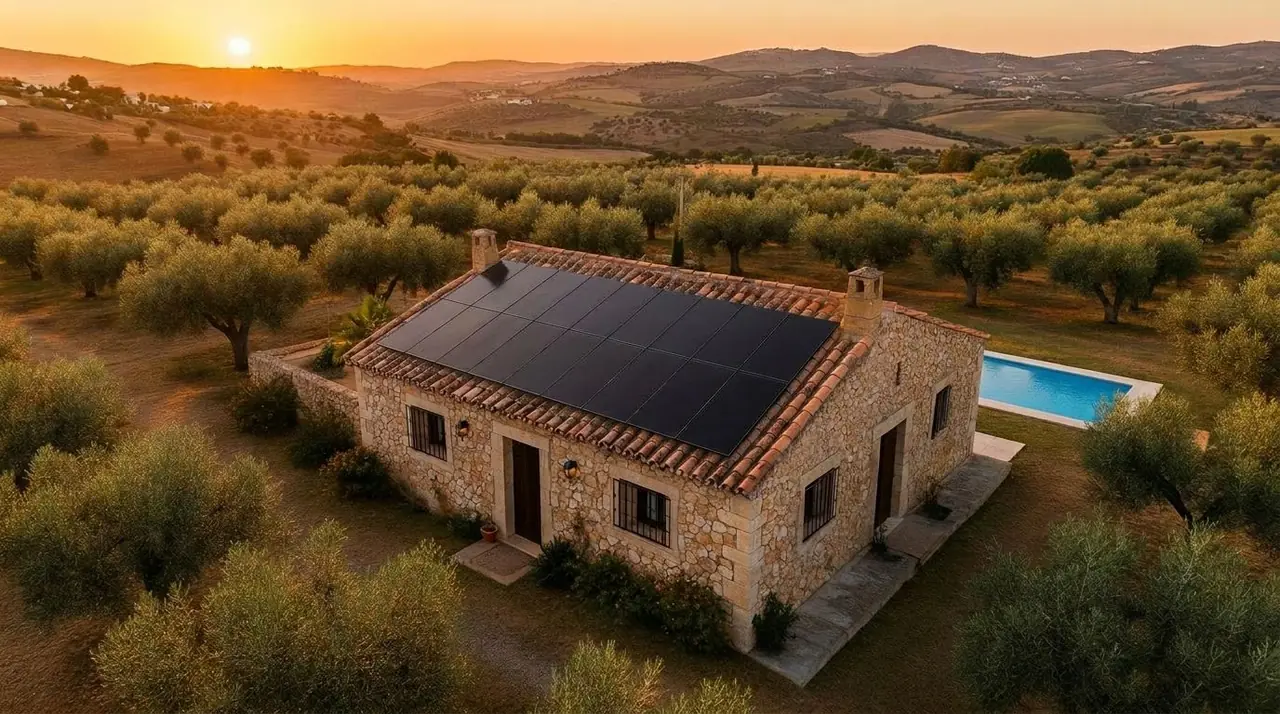

More and more clients on the Costa del Sol ask us the same question: is it worth adding a battery to my solar panels? The short answer: for most households that consume in the evening and at night, yes. In this guide we use real numbers from our own installations to show when a battery pays for itself and what it costs installed.
What a battery actually does in your system
Without a battery, the energy your panels produce at midday that you do not use flows to the grid at a low price (0.06–0.10 €/kWh depending on your retailer). With a battery, that energy is stored and used at night, when electricity costs 0.18–0.25 €/kWh. The difference is your saving.
A well-sized 10 kWh battery raises a typical home's self-consumption from 30–40% to 70–85%.
What a battery costs installed (real 2026 prices)
These are the turnkey prices we apply today in Málaga and the Costa del Sol:
This includes the battery, hybrid inverter or retrofit, protections, labour by our own team and legalisation under RD 244/2019. Full breakdown on our batteries for solar panels page and item-by-item examples in our itemised quotes.
When it pays for itself: three client cases
If your night-time consumption is low (for example, a second home empty during the week), the battery takes longer to pay back, and we sometimes recommend waiting or starting with an expandable 5 kWh unit.
Physical battery or virtual battery
A virtual battery is not a battery: it is a euro balance your retailer gives you for surplus energy. It is free, but usually has monthly limits and does not protect you from a power cut. A physical battery costs more, but gives you real autonomy and also works during an outage (with a backup system). Many clients combine both: the physical one for daily use and the virtual one for summer surpluses.
What we install
We work with Huawei, Deye and Sungrow, always with an official warranty in Spain and installation by our own team from Coín — no subcontractors. All the batteries we install are modular, so you can start with 5 kWh and expand later.
Want to know which battery fits your home?
Request your free study: we analyse your consumption curve, tell you with numbers whether a battery makes sense and give you a fixed price within 24 hours. More information and updated prices on batteries for solar panels.
Frequently asked questions about solar panel batteries
What is the payback period of a solar battery?
On the Costa del Sol, a 5 kWh battery (from €3,500 installed) typically pays for itself in 5 to 7 years. The maths is simple: without a battery you export surplus energy at around €0.06–0.10/kWh, while the electricity you buy at night costs €0.18–0.25/kWh. Every kWh you store and use yourself saves you that difference. With typical night-time consumption of 8–12 kWh per day (air conditioning, pool pump, EV), the saving is around €500–900 per year. Larger 10 kWh systems in villas with high evening consumption often pay back even faster, in 4 to 6 years.
How much does it cost to add a battery to an existing system?
The turnkey price depends on capacity: around €3,500 for 5 kWh (Huawei LUNA2000 or similar), €5,500–7,900 for 10 kWh, and up to €14,000 for 20 kWh villa systems. That price includes the battery, installation by our own team, commissioning and legalisation. If your current inverter is not hybrid, it may need replacing or an additional battery inverter; we always check this during the free technical visit before quoting a fixed price.
Can a battery be added to any existing solar installation?
In practice, yes. Almost any existing installation accepts a battery via retrofit: either AC-coupled on the alternating-current side, or by replacing the inverter with a hybrid model. We work with Huawei, Deye and Sungrow because their batteries are modular: you can start with 5 kWh and expand later without changing the system. Installation is carried out by our own team from Coín and usually takes a single day, including setting up the monitoring app on your phone.
What paperwork is needed to install a battery in Andalusia?
For a home battery, a declaración responsable or prior notice to the town hall is normally enough, plus an updated electrical certificate if the installation is modified. We handle the legalisation with the Junta de Andalucía and the grid operator (under RD 244/2019) from start to finish: you do not have to file a single form.
Is a physical battery or a virtual battery more worthwhile?
It depends on your consumption. If you use a lot of electricity at night (air conditioning, pool, EV), a physical battery is usually more profitable because you use 100% of your own energy. If your consumption is low and your surplus small, a virtual battery may be enough and requires no upfront investment. During the technical visit we compare both options with your real consumption data.
See prices, brands and how we install batteries →
Solar batteries in Marbella, Estepona and Málaga: what we see on the ground
We install batteries every week between Marbella, Estepona and Málaga city, and the pattern repeats itself. In Marbella, villas with pools and central air conditioning dominate: the 10 kWh battery is the most requested option there, because night-time consumption from cooling and the pool pump justifies the extra capacity and brings payback below 6 years. In Estepona we mostly see townhouses and holiday apartments with summer-peaked consumption; for those cases we usually recommend starting with 5 kWh and expanding later, since Huawei and Sungrow batteries are modular. In Málaga city, with more year-round homes and owners' communities, the winning combination is panels on a communal roof plus one battery per home, taking advantage of the IBI rebate several municipalities in the province offer.
In all three areas the starting point is the same: a free technical visit where we measure your real night-time consumption before talking about capacities or prices. Request your assessment on the solar battery page or directly via your city.
Source: MiTechoSolar.com, Premium solar energy on the Costa del Sol
Installed by Mi Techo Solar · Professional solar panels, batteries & EV chargers · mitechosolar.com